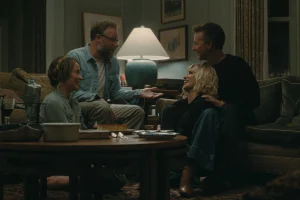

A new Czech-Austrian production will tell the story of Mitsuko Aoyama, a Japanese woman who became a countess in Bohemia at the end of the 19th century. The film, combining documentary interviews with dramatized scenes, explores her journey from Tokyo to the Austro-Hungarian Empire and her life raising seven children far from her homeland.
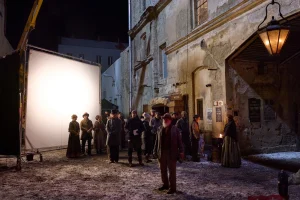
Filming for the project took place last autumn at the historic château in Poběžovice, a key location in her story, and involved the direct participation of her descendants.
Rather than focusing on spectacle, the filmmakers are leaning into the human dimension of cultural displacement, resilience and legacy. It is this layered historical background—rooted in real locations still standing in the Czech Republic—that makes the production notable within the current slate of Central European historical films.
A cross-cultural marriage that unsettled Bohemia
Mitsuko Aoyama’s arrival in Bohemia in the 1890s came at a time when Japan had only recently emerged from more than two centuries of self-imposed isolation. Her marriage to Austro-Hungarian diplomat Heinrich von Coudenhove-Kalergi was unusual not only socially, but geopolitically. Few Japanese women had settled in Europe at the time, and even fewer had entered the aristocracy.
After meeting Heinrich in Tokyo, where her father ran an antiques shop frequented by European diplomats, Mitsuko married against her family’s wishes. She was disinherited and left Japan permanently, converting to Catholicism before moving to Europe. By 1896, the couple settled at the family estate in Poběžovice, then part of the Austro-Hungarian Empire.
For the local population, the presence of a Japanese countess was a shock. According to director Alfred Ninaus, who is leading the Austrian side of the production, the story resonates because it captures a moment when two vastly different cultures were forced into daily contact. “These were worlds that had to learn to understand one another,” he told Novinky.cz during filming at the château.
The film explores how Mitsuko navigated this environment, raising her children in a foreign language and culture while managing the estate. After Heinrich’s death in 1906, she was left a widow at 32, responsible for seven children and a complex web of property and legal obligations. Despite limited formal education and linguistic barriers, she successfully defended her guardianship and maintained control of the family holdings.
Czech Television dramaturg Jakub Charvát describes her as a figure who challenges simplified narratives about women in European aristocratic history. Her strength, he argues, is evident not only in her survival, but in the later lives of her children, several of whom became influential intellectuals and public figures.
Filming legacy, not legend
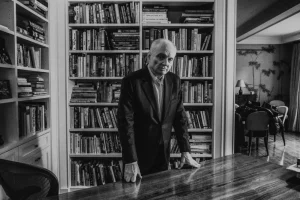
The current production does not aim to mythologize Mitsuko Aoyama, but to place her within a broader historical context that still feels relevant. The film includes commentary from historians, local figures in Poběžovice and members of the Coudenhove-Kalergi family, including Mitsuko’s great-great-grandson Richard Coudenhove-Kalergi, who appears on camera.
His involvement adds a contemporary layer to the story. He has spoken openly about how Mitsuko’s presence was felt in family memory more through images than through personal stories. That changed, he says, after renewed interest in her life over the past decade, including research by Japanese writer Masumi Muraki.
The production also situates Mitsuko’s legacy within European political history. Her second son, Richard von Coudenhove-Kalergi, later founded the Paneuropean Union in 1922, one of the earliest movements advocating European integration. While the film does not frame Mitsuko as a political thinker, it suggests that her experience of crossing borders and cultures shaped the worldview of her children.
For Poběžovice, the filming has renewed attention on a story long embedded in local memory. Municipal leaders have welcomed the project as a rare opportunity to connect regional history with an international audience, without reducing it to a tourist anecdote.
Scheduled to premiere on Czech Television later this year under the working title Mitsuko: Matka sjednocené Evropy (Mitsuko: Mother of a united Europe), the film reflects a growing interest in stories that complicate national histories rather than celebrate them.