
For more than two decades, international film and television productions have quietly relied on a shipbuilder working far from any coastline. From a workshop in Lipník nad Bečvou, Moravia, Radim Zapletal has produced historically inspired vessels that have appeared in some of the most recognizable fantasy and period productions of recent years.
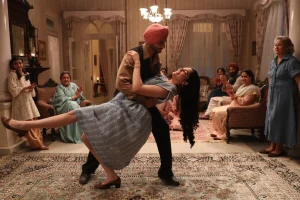
His boats have featured in projects ranging from Game of Thrones and Vikings to The Northman and, most recently, Wicked (pictured at top). While audiences rarely notice the craftsmanship behind these floating sets, Zapletal’s work has become a known quantity among production designers and art departments looking for reliability, speed, and functional authenticity.
Zapletal’s career reflects a broader strength of the Czech film industry: highly specialized craftspeople whose work underpins international productions shooting in Europe. His boats are not just visual props but working structures that must meet demanding safety and performance requirements on set.
From historical reenactments to Hollywood films
Zapletal began building ships in the late 1980s through historical reenactment, initially constructing replicas inspired by Christopher Columbus’ vessels. A planned transatlantic journey in the early 1990s ultimately fell through, but the project laid the foundation for his later work. After a long pause, he returned to shipbuilding around the turn of the millennium, when his first film commission arrived for The Mists of Avalon.
That early success led to further projects, including The Affair of the Necklace, for which he built six rococo-style swan boats in just five weeks. For major Hollywood productions, quick turnaround, Zapletal has repeatedly said, is as important as craftsmanship.
“Hollywood productions have been using my services for more than 20 years. What matters is not only skill and flexibility, but above all speed,” Zapletal recently told Novinky.cz.
His reputation grew steadily. Productions such as Van Helsing, The Chronicles of Narnia, and Tristan and Isolde followed, before a pivotal moment came with Vikings. After seeing one of Zapletal’s earlier longships, production designer Tom Conroy sought him out in 2012. Zapletal and his team ultimately built five ships for the series over four years.
Despite working on increasingly high-profile projects, Zapletal never actively marketed himself to studios. “I never tried to push my way into film or Barrandov Studios. But our first ship, Santa Agnes, was written about everywhere, so filmmakers probably knew about us.”
Designing for cameras, water, and reality
While Zapletal’s ships often appear larger and more imposing on screen, they are designed with practical constraints in mind. Longships built for Vikings typically measured around 14 meters, while The Northman featured a 17-meter warship and a wider cargo vessel. “They know how to film it so it looks even bigger,” Zapletal said in a 2022 interview with iDnes.cz.
A recurring challenge is reconciling artistic concepts with physical reality. For Wicked, Zapletal built two boats based on designs that initially ignored basic principles of buoyancy.
“It was brutal in the sense that the visual design didn’t correspond at all to a boat that should actually float,” he tells Český rozhlas. The finished vessels, however, met both aesthetic and safety demands. The film’s subsequent Academy Award for production design underscored the importance of such behind-the-scenes contributions.
Zapletal has consistently praised collaboration with U.S. productions. “Ideally, you work with Americans. They never force you to do things that won’t work,” he told iDnes.cz. According to him, art directors typically define proportions and visual intent, while technical solutions are left to his team.
Not every ship he builds is meant for water. His most recent project, for the upcoming Czech film War with the Newts, involved a 20-meter-long studio ship that will never sail. Commissioned by director Aurel Klimt, the vessel was built in six sections and transported to Prague by truck. “We normally never build non-floating ships, but this was a studio build and a very specific case,” Zapletal told Novinky.
With more than 50 ships completed and credits spanning roughly 25 films and series, Zapletal remains an example of how Czech craftsmanship continues to support international filmmaking. His work rarely draws attention on its own, but for international productions seeking credible historical worlds, his boats have become a dependable constant.