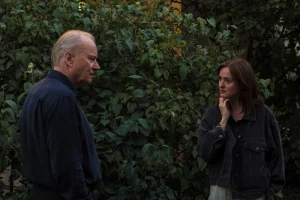

A pair of sisters reunite with their estranged film director father after he returns home to shoot a personal film in Sentimental Value, which debuted at the Cannes Film Festival, premiered in Czechia at the Karlovy Vary International Film Festival, and opens in Prague cinemas this weekend courtesy distributor Aerofilms. This tender, vividly-realized drama features a quartet of compelling performances from its central cast and firmly establishes director Joachim Trier as one of Europe’s top contemporary filmmakers.
Sentimental Value reteams Trier with actress Renate Reinsve (The Worst Person in the World), who here stars as Nora Borg, a Norwegian stage actress who suffers from intense bouts of anxiety that, in one of the film’s striking opening sequences, threaten her professional career. Her sister Agnes (Inga Ibsdotter Lilleaas), married with a young son, appears more well-adjusted, though the pair reunite at their childhood home in Oslo for a somber event: the funeral of their recently-deceased mother.
They’re joined by an unexpected visitor: father Gustav (Stellan Skarsgård), an acclaimed film director who abandoned his wife and daughters years ago as he left to pursue his film career in Sweden. He returns to the Oslo home—which his family had owned for generations—not necessarily to mourn his ex-wife or bond with his daughters, but for ulterior motives. He plans to shoot his latest movie, inspired by the life of his mother, who served in the Nazi resistance movement and suffered the consequences, at the location where she took her life.
Gustav wants Nora, who once starred as a child actress in one of his early movies, in the leading role as his mother. When Nora outright refuses, he finds a new lead actress in Rachel Kemp (Elle Fanning), a famous American actress who was affected by the director’s earlier film at a festival screening, and later forms her own bond with him at an after party on the beach.
Written by the director and Eskil Vogt, Sentimental Value showcases a masterfully-crafted story that centers on the relationship between Gustav and Nora while never explicitly addressing it; the long-standing family tension builds over every scene while the screenplay carefully avoids cliché. A lesser film would contain emotional scenes between these two characters that directly reference their past and comment on their future, but this one is able to get all that across in far more nuanced fashion through subtle inference.
The film’s finest scenes include quiet moments of realization, such as when Gustav confronts his own mortality in the form of his longtime collaborator, a cinematographer played by Lars Väringer who he infers no longer has physical acumen to shoot his latest project. The film’s emotional highlight is an emotional embrace between the two sisters, who say more with a tearful hug than they could through pages of dialogue; these women have adjusted to their father’s abandonment in different ways, but both remain deeply affected by it.
Sentimental Value is bolstered by some incredibly affecting performances in the central roles, but Skarsgård, who introduced the movie in Karlovy Vary, gives what might be a career-best performance in what will undoubtedly receive awards season recognition. His world-weary director who lives with the choices he has made but pushes on relentlessly out of blind commitment is vividly realized, and undoubtedly informed by the actor’s own cinematic career.
Skarsgård is matched beat for beat by his three younger co-stars. Reinsve is given some of the film’s showier emotional moments, but Lilleaas is just as engaging as her counterpart, the sister who has internalized what Nora wears on her sleeve. Fanning, too, is memorable as Gustav’s new stand-in daughter, forming a close bond with the director while still registering as someone perpetually on the outside looking in.
On a technical level, Sentimental Value is marked by a quiet precision that reinforces its emotional themes without calling attention to itself. Trier and cinematographer Kasper Tuxen favor restrained compositions and naturalistic lighting, allowing scenes to unfold with an unforced intimacy that mirrors the characters’ tentative attempts at reconnection. The Borg family home, shot with a patient attentiveness to its textures and spaces, becomes an extension of the drama itself, its aging interiors carrying the weight of shared memory and unresolved tension.
Sentimental Value makes for a fascinating comparison to Jay Kelly, Noah Baumbach’s recent Netflix drama, which couldn’t be more different in presentation but contains a number of strikingly similar scenes involving cinematic legacy, film festival tributes, and troubled father-daughter relationships shaped by abandonment in pursuit of a career in motion pictures. While the George Clooney film was worthwhile in its own right, Trier’s operates on an entirely different level.
This film is ultimately less concerned with the redemptive power of art than with the risks involved in using it as a substitute for emotional reckoning. Trier approaches that idea with empathy rather than judgment, allowing his characters to remain flawed, defensive, and frequently contradictory. The result is a mature, deeply felt drama that trusts its audience to sit with discomfort and ambiguity—offering no easy catharsis, but something richer and more lasting instead.