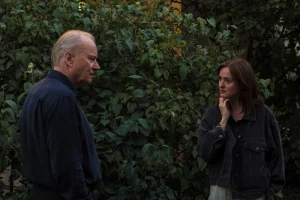


Should a recently deceased woman spend the eternal afterlife with the husband she shared six decades with, or her first love who died too young? That’s the gist of Eternity, opening in Prague cinemas and worldwide this weekend, and while the answer may seem obvious to some, this touching new comedy from director David Freyne does a nice job of balancing existential and romantic quandaries—even if the script, by the director and co-writer Patrick Cunnane, writes itself into a corner it doesn’t entirely escape from.
Eternity largely takes place in a kind of heavenly distribution center: the place recently-deceased souls find themselves before deciding where to spend forever. They only get one single choice—among an endless array of amusing options like 19th century Ireland without the potato famine or Weimar Germany without the Nazis—before they’re whisked off to permanent vacation. If they try to leave, they’ll be sent to a black void that represents the closest thing this afterlife has to Hell.
Unlike the ghoulish Afterlife Counseling Center in Beetlejuice, which froze souls at the moment of death, the recently deceased here revert to their physical embodiment of when they were most happy in life. That means that when Larry (Barry Primus) kicks the bucket after choking on a pretzel, he wakes up in Eternity as Miles Teller…and stumbles around in disbelief before Anna (a scene-stealing Da’Vine Joy Randolph) explains the rules of the game.
There’s a lack of spiritual fulfillment in Eternity—quite literally, as there’s no God, and pamphlets designed for each religion explain how practitioners have wasted their time. Everyone ends up in this bureaucratic nightmare, and unlike The Good Place, there’s no pretense: it is what it is, and each soul is processed and filed along with everyone else. You’d think these souls would eventually go mad waking up in an inescapable Groundhog Day—regardless of their chosen final destination—but the movie never confronts the darker implications of its premise.
Larry seems to inherently know that wherever he goes doesn’t matter—what matters is that he goes there with his loving wife Joan (Betty Buckley), with whom he shared 65 years and raised a family. Good news (for him, anyway): Joan is dying of cancer, and should be with him shortly. He uses his time to research the afterlife options, and settles on the questionable paradise of Beach World, before Joan (now Elizabeth Olsen) finds herself in the Great Beyond soon after her husband.
Bad news: Joan’s first husband Luke (Callum Turner), who died in the Korean War, has also been hanging around. And this guy has been waiting for her for more than 65 years, serving a lifetime as a bartender in the afterlife transportation center while staving off paradise. Joan has a difficult choice to make, but her afterlife counselor Ryan (John Early), along with Anna, negotiate with their higher-ups to aid her decision: she gets a pair of short afterlife vacations with Larry and Luke before having to make a call on her eternal resting place.
There are really only a small handful of rules to the afterlife of Eternity, but the film never really explores the world it has created: surely, the increasingly large number of human souls would at some point rebel against this maddening bureaucracy? The movie references a great many visions of the afterlife, from Albert Brooks‘ Defending Your Life to Vincent Ward’s What Dreams May Come, and feels especially similar to Czech director Otakar Votoček’s wonderful Wings of Fame, starring Peter O’Toole and Colin Firth—all of which offered much more satisfying visions of the afterlife.
But Eternity isn’t as interested in its fantastical world as it is in its characters, and that’s where the film shines. Teller, Olsen, and Turner all offer compelling performances, and turn the central dilemma into a heartfelt meditation on the very nature of love. There’s some real character growth, and at least the seeds of a powerful theme: that our eternal happiness does not lie in the comfort of others, but in our own contentment and understanding of ourselves.
Eternity ultimately works because it keeps its focus on these emotional stakes. While the script never fully grapples with the larger implications of its premise, the film benefits from crisp, bright cinematography by Ruairí O’Brien, which gives the afterlife a clarity and warmth that feels refreshingly different from the muted tones dominating recent studio films. Anchored by strong performances and a genuinely affecting central question, this is a thoughtful, charming exploration of the meaning of love—both in life, and beyond it.