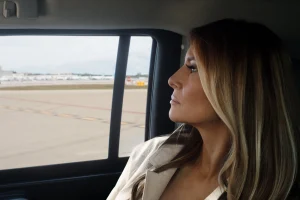

The First Lady of the United States struts around during the 20 days leading up to her husband’s 2025 inauguration in Melania, opening in around 40 cinemas across the Czech Republic this weekend through distributor Forum Film. The worldwide theatrical release of this film has expectedly sparked a politically charged reaction, but there is genuine interest in an inside look at a figure who has largely remained out of the spotlight amid her husband’s media storm over the past decades.
And as director Brett Ratner‘s drone cameras swirl around Mar-a-Lago, The Rolling Stones’ Gimme Shelter livens up the soundtrack, and Melania Trump struts around her empty palace like Jackie Siegel in The Queen of Versailles, there is promise that Melania might offer some real behind-the-scenes insight into the life of the First Lady, intentional or not. Unfortunately, that promise goes entirely unrealized.
As produced by Ms. Trump herself, Melania is a deadening, tone-deaf vanity project that lands with such a whimper that it’s shocking that it came from a camp known for their media savvy. Drained of the expected political bias—the movie is pro-immigration, anti-war, and entirely respectful of figures like Joe Biden and Kamala Harris—it’s hard to isolate any grain of interest that viewers from any spectrum might be able to take away.
What does Melania do? Not much. Over the first half of the film, she’s escorted from meeting to meeting in New York City by a security detail. She wears the same poker face whether chatting with Brigitte Macron over Zoom, embracing October 7 survivor Aviva Siegel, or chatting with fashion designer Hervé Pierre, who she’s been working with for eight years. Whatever is going on behind Melania’s eyes is the great secret this documentary never reveals.
“I hear it’s an anniversary,” Ratner says from behind the camera, in a vain attempt to prompt an anecdote. He gets a smile and laugh from Hervé, who explains that he and Mrs. Trump first met eight years ago. But Melania carefully sidesteps any attempt to reveal backstory, insight, or human emotion.
Melania praises the dresswork while making some minor requests for alterations, and takes down a handwritten note while speaking to Mrs. Macron on the topic of social media and technology among children: “no phone until the age of 11.” These, somehow, are the most compelling scenes in the movie.
The second half of Melania follows its subject on inauguration day as she slowly fades into the background and her husband assumes the spotlight, and the movie turns into an unending montage of footage of an event we already saw on TV, for free, a year ago. Now we get to experience it all over again, with zero additional insight or context.
In stark contrast to his inscrutable wife, Donald Trump is an open book who be can read at every moment, and someone who understands that his many faults make him far more compelling than the typical anodyne politico. He lends the film its two finest moments, a line of speech inelegantly cribbed from Melania and a late-night snack on inauguration day, and hints at the kind of fascinating Kardashian-like angle that could have made this documentary truly interesting.
Melania, meanwhile, can never be less than Mother Teresa, and spends nearly every moment of this movie looking reverent and elegant and picture-perfect. Ratner cuts to Kamala checking her watch on inauguration day in what appears to be intended as a slight, but we’re doing the same in the cinema. That’s one thing the producers never grasp: this single relatable action makes Harris more human than Melania appears over the course of the entire film.
After ninety minutes, as Mr. and Mrs. Trump leave the stage at the Liberty Ball, Melania flashes a smile at the camera as she mimics some moves from the Village People’s YMCA. It’s the first time in the film that she has displayed any kind of emotion, and it appears genuine. It’s the kind of intimate moment any good wedding videographer attempts to capture, and Ratner nails it.
But we still have the rest of the movie to reckon with, and even an inspired soundtrack that could have been a Guardians of the Galaxy mixtape (Michael Jackson’s Billie Jean, Tears for Fears’ Everybody Wants to Rule the World, Spandau Ballet’s True, and much more) can’t drum up interest in anything that’s unfolding onscreen.
No less than 10 postscripts inform us of all the great things Melania has achieved in the past year, from rescuing Israeli hostages to raising money for foster children ($25 million, the film specifies—$3 million less than Mrs. Trump was paid by Amazon for this movie, per The Wall Street Journal). It’s not implausible that her advocacy has led to real results, but none of that is even hinted at by anything captured on camera here.
Melania is competently made, even if many crew members removed their names from the project (Rufus T. Firefly, Groucho Marx’s character in Duck Soup, is credited as post-production supervisor), and like its subject, carefully avoids sparking any kind of controversy. But that only results in an experience that doesn’t even provide opportunities for ironic fun. This may be the dullest movie to ever achieve a wide theatrical release.