
A convict is welded into a rusty submarine and plunged into the depths of an ocean of blood in Iron Lung, which debuts in Prague and cinemas worldwide this weekend. This claustrophobic indie horror film from YouTuber-turned filmmaker Mark Fischbach, known to most as Markiplier, is intense and richly atmospheric, if a little long in the tooth, and outdoes similar Hollywood projects going for the same vibe (*cough* Return to Silent Hill *cough*). And it signals some real talent both behind and in front of the camera: exciting debuts like this are rare events at the multiplex.
Based on the video game developed by David Szymanski, Iron Lung is set in a far-flung future where humanity has colonized the cosmos—but seen all stars and planets disappear during an event called the Quiet Rapture. Only those aboard space vessels have been left alive, and now seek the resources needed to sustain life—which just might be located within a vast ocean of blood on a distant moon.
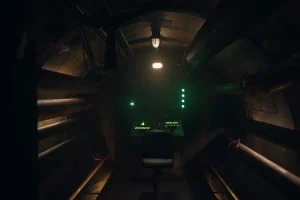
Fischbach, who adapted the game and directed Iron Lung, also stars in the lead role of Simon, the convict who is sent into the blood-ocean in search of evidence that neither he, nor we, quite understand. Outside of a few brief flashbacks, the movie is confined entirely to the suffocating interiors of his darkened vessel, which has more of a Soviet industrial aesthetic than advanced sci-fi. We know precious little about this mission, but that’s the point: neither does he.
The submarine has basic controls, and Simon begins to map out his course using coordinates on a grid. He cannot see anything in the blood ocean, but can take vague, grainy pictures of what’s outside using an x-ray camera. When he spots what looks like some kind of malformed skeleton, his radio contact Ava (Caroline Kaplan) instructs him to bring it up to the surface. But that’s when Simon realizes he isn’t alone in the ocean’s depths.
Iron Lung starts out with a lot of unanswered questions—those who have played the game will have an advantage over viewers coming into the movie fresh—but Fischbach’s script does a great job at teasing out backstory and exposition with just enough mystery to keep us curious. That also has a drawback: we know so little about this world, and the central character that inhabits it, that some of the climactic events and revelations don’t hit as hard as they might have if we were more familiar with the reality of the film.
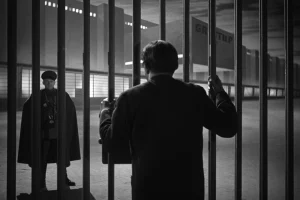
Through some fractured flashbacks, we learn the reason for Simon’s imprisonment: he was a member of a resistance group responsible for the destruction of a space station. The sense of guilt adds psychological tension, and Fischbach’s impressive performance captures it with a coiled, slow-burn intensity. While Simon is largely obscured in early scenes—hidden behind heavy clothing and tight camerawork—we gradually see more of him as the film progresses, creating a growing sense of connection to the character.
Philip Roy’s cinematography endlessly tracks and pans across every lever, wire, and button in the submarine’s interior, creating a striking sense of place and utilizing some striking close-ups that feel almost impossibly intimate. We are constantly aware of our confinement alongside Simon, even as shadows deepen and darkness swallows much of the frame.
But the real standout in Iron Lung‘s production is Andrew Hulshult’s throbbing industrial soundtrack, present in the background of almost every scene, weaving unease into moments where the narrative itself pauses. The soundtrack drives the tension, amplifying the dread that the visuals alone could not fully convey.
Iron Lung runs a long-ish 127 minutes, and while the slow-burn pacing rarely lags, the story could easily have been trimmed: the narrative is so sparse that it feels like half an hour could have been excised from the final cut without losing much. Though the film is never overtly scary, it excels at building sustained unease, culminating in a final 30 minutes that are genuinely intense.
For a debut indie feature from a YouTube creator, the film marks an impressive, if niche, achievement. Fischbach proves he can translate his creative vision into a fully realized cinematic world, supported by a skilled crew and a taut, immersive design. While not flawless, Iron Lung is a blood-soaked, nerve-wracking ride that marks a promising debut; releasing this weekend alongside Send Help, the latest film from Sam Raimi, it even invites comparison to his original Evil Dead.