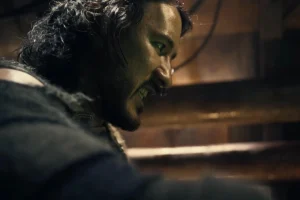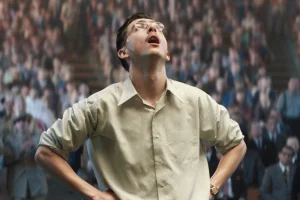

A young hustler and table tennis champion risks everything he doesn’t have to pursue his dream in Marty Supreme, now playing in Prague and cinemas worldwide. This cinematic stress test from filmmaker Josh Safdie follows in the footsteps of the director’s Good Time and Uncut Gems in escalating the rat-a-tat tension to almost unbearable levels; the raw energy combines with phenomenal production design recreating 1950s New York City, offbeat casting of colorful characters, and Timothée Chalamet‘s peerless lead performance, which oozes the charisma of a 1970s Dustin Hoffman or Al Pacino.
Written by the director and collaborator Ronald Bronstein, Marty Supreme is a brilliant deconstruction of the narcissistic male ego: Chalamet’s Marty Mauser has the weight of the whole world on his shoulders, but he’s placed it there himself. When we first meet Marty in 1952 Manhattan, he has his sights set on traveling to the British Open table tennis tournament, and nothing will get in his way—even if he has to rob his uncle’s shoe store at gunpoint to retrieve the money he’s owed.
At the London tournament, it’s not enough for Marty to topple the competition: he has to do it in style. While other players have to put up with dormitory housing, he worms his way into the Ritz-Carlton and wrangles an interview in The Daily Mail; when he spots onetime film star Kay Stone (Gwyneth Paltrow) in the lobby, he attempts to insert himself into her life. But Marty is looking beyond a romantic entanglement—he also sets his sights on her husband, wealthy pen magnate Milton Rockwell (Shark Tank‘s Kevin O’Leary) as a potential source of investment to achieve his dreams.
These early scenes establish Mauser as a classic Sammy Glick-like antihero: a smart, smooth-talking but completely graceless young hustler willing to step on everyone in his way to get a leg up. But there’s one key difference between him and Leonardo DiCaprio in The Wolf of Wall Street or Adam Sandler in Uncut Gems. We understand and identify with the pursuit of money or the thrill of gambling, but we come into Marty Supreme on the side of Marty’s mom (Fran Drescher) and uncle Murray (Larry ‘Ratso’ Sloman) in dismissing his ambition. Table tennis?
It’s credit to Chalamet that Marty Supreme works as well as it does: not only does he have to sell us on buying into this antihero, but he has to sell us on his crazy dream as well. Safdie is keenly aware of this, and the climactic table tennis scenes between Marty and Japanese rival Koto Endo (played by real-life table tennis champion Koto Kawaguchi) are still entirely irrelevant to any bigger picture, even in the world of table tennis. But because they are so utterly crucial to Marty himself, they work on the level of the best sports films.
Make no mistake: Marty is the villain here. During the film’s prolonged second act, in which he scrambles around New York to raise funds for the Tokyo tournament, he lets everyone around him down: fellow hustler Wally (Tyler the Creator), friend and supporter Dion (Luke Manley), and, most importantly, Rachel (Odessa A’zion, in a breakthrough role), who happens to be eight months pregnant with his child. Anyone who happens across his path—including a mobster played by director Abel Ferrara and a New Jersey farmer played by magician Penn Jillette—comes to deeply regret it.
Was it all worth it? The film’s final scenes contextualize everything that happened over the course of the movie, and give Marty an unexpectedly tender moment. But don’t confuse his display of emotion for genuine care: this man is the ultimate narcissist, and sheds a tear not for others but for the impact others have on him. Marty Reisman, the real-life figure the film is based on, would continue chasing the dream for another 50 years, playing ping pong (and winning titles) into his 70s.
Safdie’s direction and editing (with Bronstein) are the engines driving Marty Supreme‘s relentless momentum: he crafts a breathless rhythm that weaponizes momentum itself, creating the sense that Marty is always one bad decision away from catastrophe, that next bathtub can fall from the ceiling at any moment. The result feels entirely in line with Safdie’s previous films, while making an interesting comparison to brother Benny Safdie’s recent solo effort, The Smashing Machine, which was notably drained of this kind of manic energy.
The director’s fondness for unusual casting choices further heightens the realism: non-actors and real-life figures populate Marty’s orbit, including multiple professional table tennis players, playwright and filmmaker David Mamet as the director of Kay’s play, and fashion designer Isaac Mizrahi as her manager. That heightened realism extends to the film’s extraordinary period detail: costumes, sets, and locations spanning three continents are meticulously convincing, grounding the film in a tactile sense of time and place.
Cinematographer Darius Khondji keeps us perpetually off balance, shifting between extreme close-ups, handheld street photography in New York, and wider compositions that never quite offer relief. Daniel Lopatin’s propulsive score, an ’80s synth throwback reminiscent of Tangerine Dream, adds to the fever dream, complemented by inspired needle drops like New Order’s The Perfect Kiss and Tears for Fears’ Everybody Wants to Rule the World.
Marty Supreme stands as both a character study and an endurance test, demanding as much from its audience as it does from its protagonist. Safdie offers no easy redemption and little moral comfort, only the thrill of watching ambition curdle into obsession in real time. Powered by Chalamet’s career-best performance and executed with ferocious precision, the film confirms Safdie as one of the most exciting voices in contemporary American cinema—and proves that no dream is too small to destroy lives.
Czech connection: At the opening World Championship tournament in London, we see four Czechoslovak players brandishing paddles with Czech flags in the group photo shot. One of them is real-life German table tennis champion Timo Boll, starring as a fictional Czech player named Vladimir Sebek, who Marty faces in the semifinals. Also: Géza Röhrig‘s Béla Kletzki mentions playing in the world championships in Prague during his memorable story.