
The paths of a hermit living within a monumental reflection on death and a young boy fighting for survival in post-apocalyptic England cross once again in 28 Years Later: The Bone Temple, a sequel to last year’s 28 Years Later and continuation of the 28 Days Later franchise opening in Prague and cinemas worldwide this weekend. This meditative horror film picks up right where its predecessor left off, and delivers an thoroughly engaging storyline that will appeal to those turned off by its flights of fancy—however, it lacks the raw energy and filmmaking innovation that Danny Boyle brought to the previous movie.
Written by Alex Garland and directed by Nia DaCosta (Candyman) and filmed back-to-back with 28 Years Later, The Bone Temple represents a striking tonal change compared to Boyle’s earlier movie despite featuring the same characters and locations. That isn’t entirely a bad thing: this dialled-in entry features a more coherent narrative that gives its unique setting and themes a little more room to breathe.
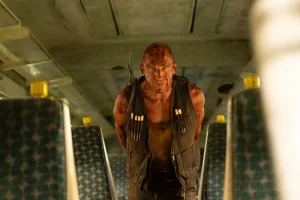
That’s most apparent in scenes featuring Ian Kelson (Ralph Fiennes), the former doctor who lives a life in solitude within the striking titular memorial made of human skeletons he has constructed over the past three decades following the outbreak of the zombie-like rage virus across England. Kelson’s memento mori meditation on death was the most compelling aspect of the earlier film, and here he gets a significant boost in screen time.
28 Years Later: The Bone Temple reunites Kelson with Samson (Chi Lewis-Parry), the infected “alpha” zombie who made a memorable impact in the previous film thanks in part to a prosthetic phallus. Samson dons some makeshift bottom wear at one point here, but fans fear not: he still gets plenty of full frontal screen time, and Fiennes, too, bares all for the camera.
Kelson is not only fascinated by death here, but also by dying, represented by the hulking Samson, robbed of humanity by the rage virus. Rather than kill the creature, the doctor sedates him via blow darts with a cocktail containing morphine, and Samson gets hooked enough on the high to peacefully return for subsequent hits. In his narcotized state, Samson seems to regain at least some element of his long-lost humanity, and recognizing this, the doctor begins to form a most unusual bond.
The tender scenes between 28 Years Later: The Bone Temple featuring Kelson and Samson make for a fascinating comparison between the contemptuous relationship between the doctor and his creation in Frankenstein. This is the rare zombie film, like George A. Romero’s Day of the Dead, in which death is treated with curiosity instead of abject horror; the infected creatures, a physical representation of our own inevitable death, are here not feared but quietly contemplated with soul-searching wonder.
But that’s only half of 28 Years Later: The Bone Temple. The other half involves Sir Lord Jimmy Crystal (Jack O’Connell) and his merry band of acrobatic Satanic killers, introduced in the previous film’s unusual epilogue, who travel the infected lands killing all infected—and non-infected—they come across. They’ve “adopted” a terrified Spike (Alfie Williams) into their ranks, and an early home invasion scene pairs the unrelenting psychological terror of Funny Games with stomach-churning horror effects.
It is these misguided youth, not the rage-fueled zombies, who are the true villains of the movie. Garland seems to be suggesting that the real enemy of society is not the older generations who act out of anger, but rather the detached younger generations who struggle to make sense of the uncaring world they have inherited. If there’s one flaw in his script here, it’s that it robs its young protagonist of agency; Spike’s character arc was the strongest element of 28 Years Later, but here he has been largely relegated to observer.
The Bone Temple‘s scenes featuring Satanic killers are a lot less interesting than those between Kelson and Samson, and Lord Jimmy’s “fingers” are largely interchangeable, though characters played by Emma Laird and Erin Kellyman each get their moments to shine. But as it becomes apparent that these two narratives will merge, the film turns more and more compelling right through a fiery climax punctuated by Iron Maiden’s The Number of the Beast.
The guerrilla style of the previous movie has been replaced by a rugged professionalism, and 28 Years Later: The Bone Temple both looks and sounds great with evocative visuals from cinematographer Sean Bobbitt (12 Years a Slave) and an elegant orchestral score from Hildur Guðnadóttir (Joker). But the film lacks that rat-a-tat energy, underscored by chant-like excerpts from Rudyard Kipling’s Boots, that Boyle used to propel the action in the earlier film, as well as Anthony Dod Mantle’s handheld digital camerawork that helped sell the horror (outside of a few jump scares, there’s nothing particularly frightening here).
Still, 28 Years Later: The Bone Temple succeeds in its profound exploration of themes involving mortality, humanity, and moral responsibility, offering a rare inquisitive meditation on death within the horror genre. By juxtaposing Kelson’s contemplative bond with Samson against the chaotic violence of the younger generation, the film examines the fragility of life, and the enduring struggle to find meaning amid devastation. Memento mori, indeed.