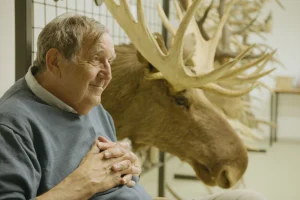
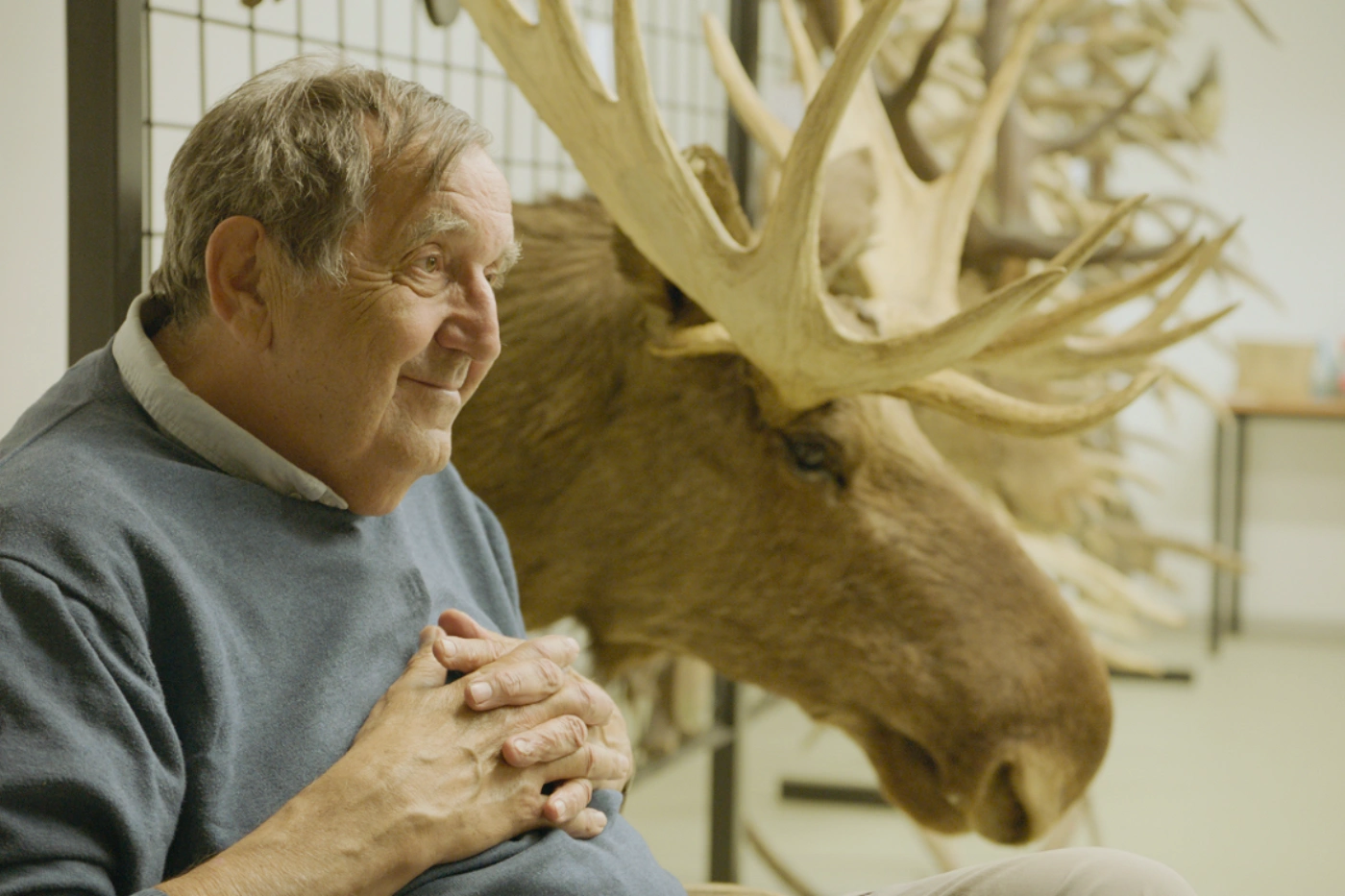
The new Czech-Slovak documentary Amoosed chronicles the improbable return of the moose to the Czech Republic after centuries of absence. Directed by Hana Nováková, the film traces her decade-long fascination with the animal, combining scientific curiosity with personal reflection. The project premiered in the Czech Joy section of this year’s Ji.hlava International Documentary Film Festival, and recently opened in Slovak cinemas. A Czech release date is still TBA.
Nováková, both a filmmaker and ethnozoologist, first encountered the story of the moose’s return in 2003, describing it as “unbelievable” in an interview with Variety. Her interest grew while studying at Prague’s renowned FAMU film school, ultimately becoming an obsession that would shape her career. Despite numerous obstacles—including lack of funding, pandemic restrictions, and geopolitical tensions—Nováková persisted, following the animal across multiple continents.
The documentary presents not only the moose as a central character but also explores the wider environmental and cultural context of its return. Through her journey, Nováková reflects on the intersections of human curiosity, scientific inquiry, and the mysterious rhythms of the natural world. The film had some real-world connections earlier this year when a rogue moose named Emil made headlines during a trek through Czechia.
Following the tracks: filming across borders
The making of Amoosed demanded an extraordinary commitment to both research and travel. With moose sightings in the Czech Republic still rare, Nováková initially traveled to Russia, visiting a nature preserve in the Kostroma region that raised the animals. This site, previously part of an anti-rocket defense installation, allowed the filmmaker to observe moose in a semi-wild environment, including a unique method for extracting milk from animals accustomed to human contact.
Her Russian expedition in 2016 provided early footage, intended primarily for scouting. Subsequent plans to film more extensively were disrupted by the 2021 Czech-Russia diplomatic crisis and the Russian invasion of Ukraine, forcing Nováková to rely heavily on previously gathered material. Later trips to Nova Scotia introduced her to the Mi’kmaq nation, whose guidance enabled her to access local moose habitats ethically and respectfully, including participation in ritual cleansings and observations of traditional animal omens.
This cross-continental approach allowed Amoosed to transcend conventional wildlife documentaries. Nováková’s meticulous documentation captures the animals’ elusive behavior while incorporating cultural insights from human communities that coexist with moose. Her scientific background informed the film’s structure, framing the moose not just as a species to be studied but as a complex and enigmatic character.
A decade-long quest and ecological reflection
Nováková’s work on Amoosed spanned more than ten years, encompassing multiple expeditions, extensive observation, and a deep personal engagement with the subject. She emphasizes that the project represents more than a film—it is part of her evolution as a filmmaker and human being. The documentary raises questions about animal behavior, such as why some moose migrate while others remain local, and the challenges of maintaining their health in captivity despite a varied diet.
Central to the film’s message is the idea of learning from nature. Nováková argues that animals, like the moose, can serve as teachers, guiding humans toward a deeper connection with the natural world. The film blends observational footage, scientific inquiry, and cultural immersion to create a contemplative narrative that examines humanity’s relationship with wildlife and the environment.
As Nováková notes, the ultimate goal of Amoosed is “purely positive,” encouraging viewers to consider the wisdom and resilience of the natural world.