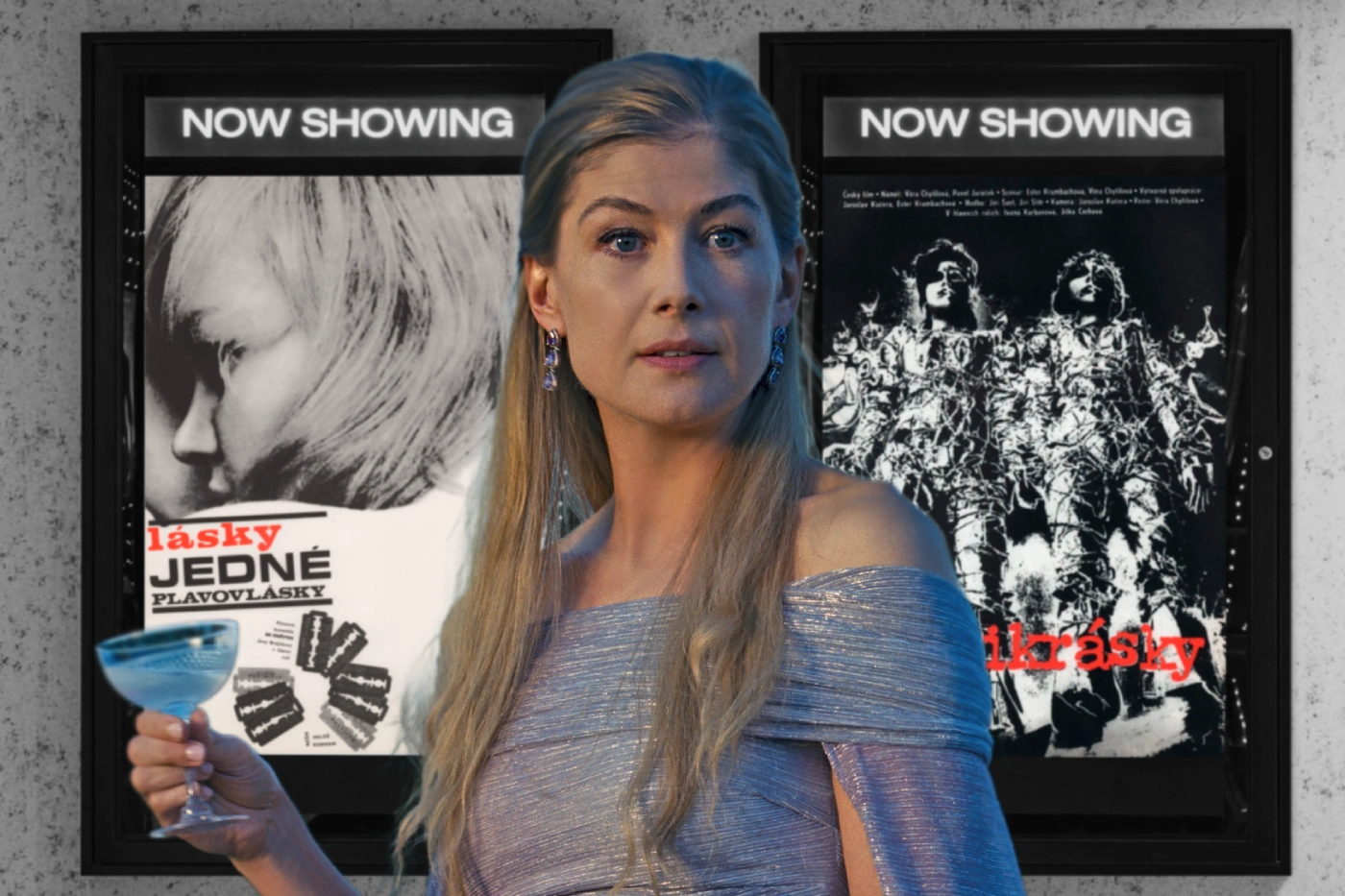
Far Out Magazine recently compiled a list of British actress Rosamund Pike‘s top 10 favorite films—a selection culled by drawing on her interviews with the Criterion Collection and Letterboxd— and the list spans decades and genres, but stands out for including two landmark Czech New Wave films: Loves of a Blonde and Daisies.
Pike’s inclusion of these films comes after spending several years living in Prague with her family while working on the TV series The Wheel of Time. Her immersion in Czech life and culture may have influenced her cinematic tastes—or perhaps confirmed an already deep appreciation for the local brand of storytelling.
Why Pike picked Daisies and Loves of a Blonde
“I’ve just spent five years living in the Czech Republic, making a television series, and the Czechs are fiercely witty and they have a dark humor that’s actually very aligned with British humor,” Pike told Criterion earlier this year, reflecting on her time in the Czech Republic.
“I think what happened in the Czech New Wave was super exciting and avant‑garde. And, you know, so much attention is paid to the French New Wave and much less to the Czech New Wave, so I’m putting Daisies in and I’m now going to hunt for a Miloš Forman film […] Loves of a Blonde, which, of course, you know, a Czech hero. And so, in honor to my new lived second country, I’m taking a bit of the Czech Republic with me.”
Daisies stands as one of the most radical films of the so-called New Wave. Directed by veteran Czech filmmaker Věra Chytilová, the 1966 film follows two young women — both named Marie — who embark on a series of anarchic, surreal pranks.
What begins as playful subversion quickly becomes an audacious satire of bourgeois decadence, societal norms, and patriarchal expectations. Scenes shift unpredictably between color and black‑and‑white, and the narrative flows like a dream — or a provocation. The filmmakers, including screenwriter Ester Krumbachová, used aggressive visual experimentation and narrative fragmentation to challenge the status quo.
Chytilová herself described Daisies as “a necrologue about a negative way of life.” The film’s tone — irreverent, disjointed, and defiantly nonconformist — made it controversial under the Czechoslovak communist regime. It was banned from major cinemas and export in 1967, while still being hailed by critics and audiences for its fearless vision.
By contrast, Loves of a Blonde, directed by Miloš Forman, takes a more grounded, humane approach. Released in 1965, it tells the story of a young woman working in a shoe factory in provincial Czechoslovakia, whose brief romantic entanglement with a visiting pianist leads her to travel to Prague hoping for love. The film utilises documentary‑style realism: on-location shooting in small Czech towns, a largely nonprofessional cast, improvisational dialogue, and a naturalistic tone.
Forman drew on a real-life encounter: a woman he once helped after she had been deceived by a man who promised her a better life in the city. That memory became the emotional core of Loves of a Blonde. The result is a film that feels intimate, raw, and socially conscious — a portrait of hope and disillusionment, desire and naivety, within the constraints of everyday life under an oppressive society.
Loves of a Blonde remains one of the most significant works of the Czech New Wave, recognised for its bold realism and its critique of the social realities of 1960s Czechoslovakia. While Daisies pushes boundaries through surrealism and formal experimentation, Loves of a Blonde does so through emotional realism and understated social critique—offering two very different but complementary visions of the Czech New Wave.
Rosamund Pike’s connection to Prague
Pike’s list suggests a serious appreciation not only for compelling stories, but for films that challenge and provoke. Her selection of Daisies highlights an admiration for aesthetic audacity, social subversion and cinematic experimentation. Her embrace of Loves of a Blonde reflects a respect for realism, empathy, and stories rooted in ordinary lives.
Given that she lived in Prague for several years during a major foreign production, Pike’s tastes may have been shaped by her time in the country—its atmosphere, culture, and cinematic legacy. In praising Czech New Wave films, she pays tribute to a generation of Czech filmmakers who risked censorship and social condemnation to make bold, honest, and artistically uncompromising films.
For international audiences—especially those interested in Czech film and culture—Pike’s list serves as a potent reminder of the power and relevance of these 1960s classics.
Rosamund Pike’s top 10 favorite films:
- Brief Encounter (1945)
- A Taste of Honey (1961)
- L’Eclisse (1962)
- Darling (965)
- Loves of a Blonde (1966)
- Daisies (1966)
- I Am Curious (1967-68)
- Mean Streets (1973)
- ET the Extra-Terrestrial (1982)
- Saltburn (2023)
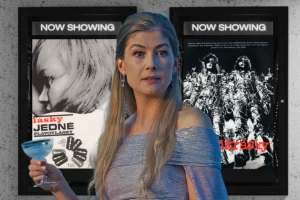
Lead photo: Rosamund Pike in Saltburn (2023) / Original posters for Loves of a Blonde and Daisies / Cinema background courtesy Depositphotos.com