
A trio of families are dryly observed in Father Mother Sister Brother, the latest effort from filmmaker Jim Jarmusch which won the top prize at last year’s Venice International Film Festival and opens wide in Prague cinemas this weekend. This playfully droll anthology varies in tone and quality from segment to segment, and not every one hits the right mark, but two out of three ain’t bad; as a whole, this slides especially smoothly into the director’s oeuvre, and ranks as his best film since 2016’s Paterson.
Father Mother Sister Brother is split across three segments, each charting a very particular and keenly observed family dynamic. In the first, titled Father, siblings Jeff (Adam Driver, in his third outing with the director following Paterson and The Dead Don’t Die) and Emily (Mayim Bialik) take a rare trip to visit their father (Jarmusch regular Tom Waits) in a rural town in the northeastern U.S. The trio make some small talk and awkwardly sit around; they meet out of familial obligation rather than any organic desire.
In what will become a trend, Jarmusch tells the life story of these three people through careful observation rather than any tangible narrative; we learn more about them through casual asides and subtle interplay more than any direct confrontation. The three actors are innately believable as members of the same family, and play off each other wonderfully; an entire film consisting of their strained dialogue might be tough to take, but as a 40-minute chamber piece it is sharply observed, patient, and quietly engrossing.
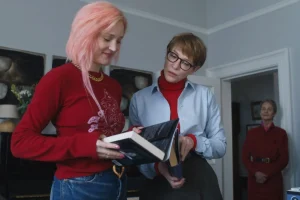
The film’s second segment, Mother, is just as strong as the first. It features Cate Blanchett and Vicky Krieps as siblings Timothea and Lilith, complete opposites who separately wind up at the residence of their mother (Charlotte Rampling) in a Dublin suburb. While this installment plays out much like the first with stilted dialogue and uncomfortable silences, we get the impression that these three characters would actually like to be closer to one another—it’s something external and unsaid that is keeping them apart.
Jarmusch hits a lot of the same notes of droll humor here, and he’s been blessed with three incredibly rich performances to wring every drop of awkward longing from the material. Blanchett and Krieps give finely modulated turns that suggest decades of rivalry, affection, and mutual misunderstanding simmering beneath every pause. Rampling anchors the segment with a performance that is restrained yet emotionally legible. The cumulative effect is subtle but piercing, a canny portrait of emotional distance that feels utterly authentic.
In Father Mother Sister Brother‘s third segment, Sister Brother, we follow fraternal twins Skye (Indya Moore) and Billy (Luka Sabbat), who reunite in a Paris café before visiting their childhood home. They meet some months after their parents’ untimely deaths in a plane crash, and unlike the characters in the previous two segments, share a deep and loving bond; the portrait of family on display here is a counterargument to what was presented earlier.
Skye and Billy seem like genuinely nice people, especially compared to the characters in the previous two acts of the film, but that also makes them a lot less interesting to watch. The notes of bittersweet melancholy that Jarmusch hits here come as a pleasant juxtaposition to what he delivered in the earlier segments, but one wishes that he wrote more compelling characters to carry them.
Making up for that, the final segment of Father Mother Sister Brother not only represents a tonal shift, but a complete visual one: while earlier segments feature a rather nondescript look and a certain digital sheen, this final one has a gorgeous cinematic quality that feels entirely different to what came before (two different cinematographers, Frederick Elmes and Yorick Le Saux, are credited on the final film). Location shooting on the streets of Paris doesn’t hurt.
Jarmusch has specialized in telling self-contained stories of disparate characters in films like Mystery Train and Coffee and Cigarettes, but typically has a stronger grasp on central motifs. Here, there are some casual observations of skateboarders in slow-motion and lines of dialogue (“Bob’s your uncle!”) but otherwise little connecting tissue to tie everything together apart from the general theme of family dynamics.
An original soundtrack composed by the director and singer-songwriter Anika is one of Father Mother Sister Brother‘s strongest assets. The evocative, minimalist score wonderfully captures the film’s sense of suspended time—those quiet, in-between moments where nothing much appears to happen. A fittingly ethereal rendition of Classics IV’s Spooky serves as a central theme, reinforcing the film’s gentle sense of irony and detachment.
Jarmusch has been one of cinema’s most distinctive voices for four decades, and Father Mother Sister Brother slides perfectly into his body of work as a subtle meditation on quiet encounters, unspoken histories, and the fragile architecture of family bonds. The anthology format allows him to explore variations on a theme with patience and precision, and even if every story doesn’t hit the right mark, the cumulative impact lingers well beyond its final image.