


A man has 90 minutes to prove his innocence during an AI-expedited murder trial in Mercy, a slick new sci-fi thriller from director Timur Bekmambetov (in his first Hollywood outing since 2016’s Ben-Hur) premiering in Prague and cinemas worldwide this weekend. The premise instantly draws us in, and solid execution maintains our interest for the majority of the movie, but a third act implosion sinks the whole enterprise and makes us question our own good taste for enjoying it in the first place.
In an era where most of us interact with artificial intelligence on a daily basis, we walk into these kinds of things with certain expectations. Mercy‘s painfully outdated interpretation of AI feels less like The Creator, Ex Machina or even M3GAN and more like 90s thriller Virtuosity: by the time Rebecca Ferguson‘s algorithm praises Chris Pratt‘s “gut instincts” and shares a meaningful nod, it has severed any sense of technological realism.
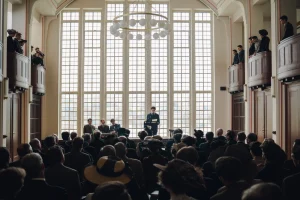
Mercy stars Pratt as L.A. police detective Chris Raven, who helped advocate for the titular technology: an AI-powered criminal justice system that serves as judge, jury, and executioner, and gives defendants 90 minutes to plead their cases before an AI judge delivers a verdict and carries out the sentence. Death sentences are instantly delivered through lethal injection, conveniently located in the chair on which defendants are restrained.
But it’s not all bad: the Mercy system bypasses any need for warrants, and gives both the AI judge and the defendant access to phone records, traffic cameras, police databases, and any other kind of evidence that could possibly be available in the cloud. Defendants should have everything they need to prove their case—save for a lawyer—but the all-knowing algorithm should already know whether or not they’re guilty.
That puts Raven in a bind when he wakes up from a hangover and a head injury before the digital Judge Maddox (Ferguson), who tells him his wife Nicole (Annabelle Wallis) has been murdered and there’s a 97.5 percent chance that he’s the killer. Raven can’t quite remember what transpired, but he knows he isn’t a murderer, and has exactly 90 minutes to get his guilt rating below 92 percent, or else he’ll be executed on the spot.
This is essentially The Fugitive, except Raven isn’t trying to prove his innocence and track down the real murderer while he’s on the run: he’s doing it all while restrained to a chair in a darkened room. Good thing he’s an actual detective, unlike the homeless men he’s put in front of the Mercy system in the past.
The setup immediately draws us in, and director Bekmambetov does a great job of ratcheting up the tension as Raven scrambles to not only save his own life, but solve his wife’s murder. As he scrambles to untangle the mystery before the clock runs out, he calls AA sponsor Robert Nelson (Chris Sullivan), daughter Britt (Kylie Rogers), and partner Jaq (Kali Reis) to help him put the pieces of the puzzle together.
All Mercy needs is a sensible resolution to succeed in B-movie terms. Maybe Raven finds the real killer, and succeeds in proving his innocence before the Mercy system. Maybe the killer gets away, and Raven’s execution becomes the impetus to bring the whole system down. Or maybe Raven really is the killer—and his inside knowledge allows him to game the system and get away.
After 75 minutes of an interesting and well-executed sci-fi murder mystery-cum-courtroom drama, any reasonable resolution would seal the deal. But instead, the utter nonsense delivered in the final act of writer Marco van Belle’s script sends this whole movie off the rails.
Key test in these kinds of credulity-testing whodunnits: walk back the events of the narrative from the point of view of the killer. What Mercy asks us to believe has transpired is not only completely baffling, but it also forces the film to completely switch gears, abandoning the premise that made it interesting in the first place.
Still, Mercy has enough technical polish to keep it watchable, buoyed by Ramin Djawadi’s propulsive score, sleek cinematography from Khalid Mohtaseb, and proficient VFX work (love that police dronecopter). Bekmambetov stages the action well, and both Pratt and Ferguson give fun performances that lean into the script’s silliness—even if Maddox is written with far too much empathy to convincingly register as artificial intelligence.
In the end, Mercy is a thriller that builds a smart, timely hook and sustains it for just long enough to make its collapse especially frustrating. The film asks provocative questions about truth and justice in the AI age of only to abandon them in favor of a finale that doesn’t withstand even minimal scrutiny. It’s a cautionary tale about blind faith in algorithms—a lesson that could have also benefitted the filmmakers.











One Response
You could tell from the trailers this was gonna be sh*t, confirmed by the move from summer to January. Looks like a C-grade Minority Report ripoff. Too bad, Rebecca Ferguson usually elevates everything she’s in.