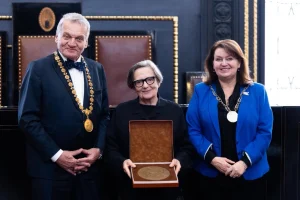

Polish director and screenwriter Agnieszka Holland was honored in Prague on Jan. 16, 2026, with the Karl IV. Award for lifetime achievement. The accolade, jointly presented by the City of Prague and Charles University, recognizes individuals who have made significant contributions to culture, science, or public life. Holland is the first woman to receive the award, joining seven previous recipients.
Holland’s connection to Prague runs deep. She studied at the Film and TV School of the Academy of Performing Arts in Prague (FAMU), directed several films in the city, and described the capital as a place where she “became who I am.” She reflected on her experiences in Prague, noting personal milestones including her marriage, completing her studies, and enduring periods of political repression.
At the ceremony in the Old Town Hall, Prague Mayor Bohuslav Svoboda praised Holland’s body of work, highlighting both her artistic achievements and moral engagement. “She is a truly extraordinary personality, and her films collectively represent a remarkable contribution to cinema,” Svoboda said.
Career highlights
Born in Warsaw, Holland began her career assisting prominent Polish directors Krzysztof Zanussi and Andrzej Wajda. She later emigrated to France in the 1980s and currently resides mainly in the United States. Her work spans more than 30 films, many of which explore politically and socially charged themes. She earned an Academy Award nomination for her screenplay to 1992’s Europa Europa.
Recently, Holland gained local attention with the miniseries Burning Bush (2013), a tribute to Jan Palach, the Czech student who self-immolated in protest of the Soviet occupation. Other notable recent works include the Polish-Italian-Czech co-production Spoor (2017) and the biographical drama Charlatan (2020), about Czech healer Jan Mikolášek. These films have earned acclaim at international festivals and won several awards in the Czech Republic, including Czech Lion Awards and Czech Film Critics’ Awards.
Her latest project, the Czech-German-Polish co-production Franz, premiered at festivals in Toronto and San Sebastián. The drama, which centers on the life of Prague-born German-speaking Jewish writer Franz Kafka, won four awards including the Silver Lion at the 50th Gdynia Polish Film Festival and earned two European Film Award nominations.
Despite critical acclaim, Franz did not make the shortlist for the Academy Awards’ Best International Feature category. However, it leads contenders for this year’s Czech Lion Awards, celebrating the best Czech movies of 2025, with 15 nominations.
Long-standing ties to Prague
The Karl IV. Award, presented biennially, honors individuals who embody the legacy of the Bohemian king through outstanding contributions to cultural and intellectual life. Charles University Rector Milena Králíčková highlighted the award’s importance in celebrating achievements that resonate beyond the Czech Republic. Holland joins a lineage of distinguished recipients recognized for their international impact.
Holland, who also received the Gratias Agit Award from the Czech Ministry of Foreign Affairs and the Bene Merito distinction from the Polish government, expressed the personal significance of the honor.
“This award is meaningful because Prague and Czech culture have been essential to me; it is not like receiving a prize in another city,” she said. In her acceptance speech, she spoke on contemporary global challenges, cautioning against populism and the spread of misinformation, and emphasized the importance of international cooperation in the arts.
The next presentation of the Karl IV. Award is scheduled for 2028, continuing the tradition of honoring individuals who advance culture, knowledge, and civic responsibility on a global stage. Holland’s recognition underscores her enduring influence on European cinema and her lasting ties to Prague, a city she calls formative both personally and professionally.
Lead photo: Agnieszka Holland honored in Prague courtesy Facebook / Bohuslav Svoboda, primátor hl. m. Prahy