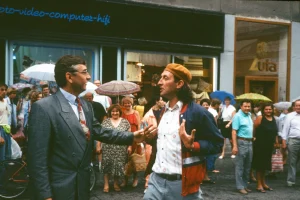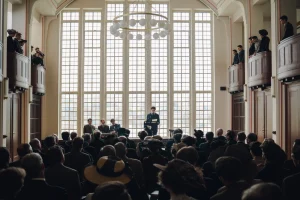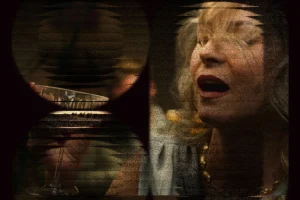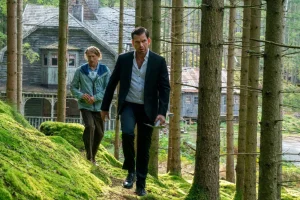

A restored version of Prefab Story (Panelstory aneb Jak se rodí sídliste), one of the most distinctive films by Czech New Wave director Věra Chytilová, will screen at this year’s Berlin International Film Festival, bringing renewed attention to a work long overshadowed within her post-1960s career. The digitized version will be presented in the Berlinale Classics section, marking its world premiere in restored form.
Originally released in 1979 under the full title Prefab Story, or How a Housing Estate Is Born, the film offers a sharply observed social satire set in a newly built prefabricated housing estate on the outskirts of Prague. Though completed earlier, the film was not approved for release in communist Czechoslovakia until two years after its completion, reflecting the uneasy position Chytilová often occupied with cultural authorities.
The Berlinale screening comes as part of a broader Czech presence at the festival this year, with several new films involving Czech producers also set to premiere across different sections of the program. Together, the lineup highlights both the country’s contemporary international collaborations and a renewed interest in preserving and contextualizing its film heritage.
A belated classic returns in restored form
Prefab Story stands apart even within a body of work known for formal experimentation and political edge. While Chytilová achieved international recognition with Daisies in 1966, many of her later films received limited circulation outside Czechoslovakia. Prefab Story is now widely regarded by critics and programmers as one of the strongest examples of her post-New Wave filmmaking.
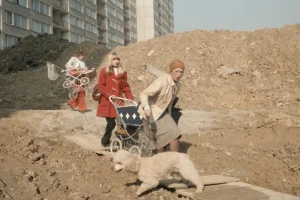
Set amid the muddy pathways, unfinished buildings, and makeshift social spaces of a sprawling housing estate, the film portrays a cross-section of residents navigating everyday frustrations, petty conflicts, and unfulfilled promises. Using a loose, episodic structure, Chytilová blends documentary-style observation with exaggerated comic moments, exposing the gap between the utopian ideals behind mass housing projects and the realities of daily life.
The newly restored version was digitized from the original picture and sound negatives held by the National Film Archive in Prague. The restoration aims to preserve the film’s raw visual texture while improving image stability and sound clarity, allowing contemporary audiences to experience the film closer to its original form. According to Berlinale materials, the restoration also serves to reintroduce the film to international audiences largely unfamiliar with Chytilová’s later work.
The film stars Lukáš Bech, Antonín Vanha, and Eva Kacířková, though its focus remains less on individual protagonists than on collective behavior and social dynamics. Through slapstick humor, abrupt tonal shifts, and jagged editing, Chytilová constructs a portrait of a society in perpetual transition—both literally unfinished and ideologically frayed.
Czech projects across the Berlinale program
Beyond Prefab Story, Czech involvement at this year’s Berlin International Film Festival extends to several new productions screening in competitive and non-competitive sections. At least three films with Czech co-production backing are included in the festival’s lineup, underscoring the country’s continued role as a key European production partner.
In the Generation Kplus section, the short animated film Eeny, Meeny, Miny, Moe! (En, ten, týky!), directed by Andrea Szelesová, will have its world premiere. The film marks the first professional work by the FAMU graduate and was developed as a Czech-Slovak co-production. Drawing on elements of classical mythology, it follows a young boy grappling with his identity as the son of a Greek god.
The Panorama section will host the world premiere of Roya, a feature by Iranian director Mahnáz Mohammadi and a co-production involving the Czech Republic, Germany, Luxembourg, and Iran. The film centers on an Iranian teacher imprisoned for her political views, continuing Mohammadi’s focus on women’s rights and political repression. Her earlier film Son-Mother also involved Czech partners.
In the Forum section, documentary If Pigeons Turned Into Gold by Pepa Lubojacki will debut as a Czech-Slovak co-production. Filmed over three years, the documentary follows four relatives, exploring the distance between shared childhood memories and adult realities.
The 76th Berlin International Film Festival runs from Feb. 12 to Feb. 22, with the main competition titles to be announced separately. The presence of Czech and Czech-backed films across multiple sections reflects both the diversity of Czech-related production and Berlin’s role as a platform for politically engaged and formally adventurous cinema.