
The life, work, and continued relevance of author George Orwell is probed in Orwell: 2+2=5, which premiered at this year’s Cannes Film Festival and is now playing in Prague cinemas. This latest documentary from director Raoul Peck (I Am Not Your Negro) is thoroughly compelling when it sticks to Orwell and his work, but the attempt to draw parallels to contemporary events is so sweeping and overstuffed that it struggles to stay coherent.
Comprised entirely of archival material, including early 20th century photographs of Eric Arthur Blair (who would adopt the pen name of George Orwell) and various adaptations of his work, Orwell: 2+2=5 is empathetically narrated by Damien Lewis in Orwell’s own words. The actor recites passages from Orwell’s novels, largely 1984, and his personal letters, and lends the film a quiet gravitas that feels like the author telling his own intimate story.
Much of the personal material comes from the late 1940s, when Orwell, in ill health, lived with his adopted two-year-old son on the rural island of Jura off the Scottish coast. Here, while writing what would become 1984 in the final years of his life, the author shares an unusually perceptive vision of his life through correspondence with friends and colleagues.
Eric Arthur Blair was born in India to what the author describes as a “lower-upper-middle class” family: not affluent enough to live among the landowners in Britain, but not poor enough to toil among the working class, they found happiness in a foreign land where they could assert a natural supremacy over the native population. One of the most memorable images in the film is of an infant Orwell in loving arms—not of his mother, but of his Indian caregiver.
Raised within this system, a young Orwell found himself a part of it, and through Lewis speaks of how he asserted his dominance while in the British military—over both his own subordinates, and the local populations in India and what is now Myanmar. Pain and suffering is the language of class dominance, and Orwell speaks of the bitter shame he felt when he later came to terms with his actions, and how it led him to political advocacy both through direct personal action and within his written work.
Orwell’s words are backed up through archival footage, including the 1966 Class System sketch with John Cleese, Ronnie Corbett, and Ronnie Barker, which nicely encapsulates how much of the world operates, both at the time of Orwell’s birth in 1903 and still—perhaps even more so—today. This is the great lie that dictates how so many of lead their lives, and so few are able to extricate themselves from. Orwell was one of the lucky few. But he was only halfway there.
“I had reduced everything to the simple theory that the oppressed are always right and the oppressors are always wrong,” Lewis speaks as Orwell, quoting from The Road to Wigan Pier. “A mistaken theory, but the natural result of being one of the oppressors yourself.” A poignant later scene features Czech author Milan Kundera re-evaluating Orwell’s writing through his lived experiences in much the same way.
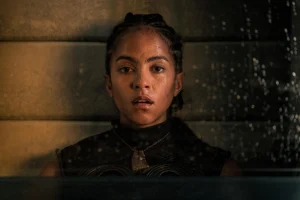
Orwell: 2+2=5 is a terrific overview of Orwell’s early and later years, and backed with extensive footage from the 1983 BBC TV production Crystal Spirit: Orwell on Jura, which memorably features the titular 2+2=5 equation, as Orwell tells his son how those in positions of dominance control their subordinates through lies. Scenes from various versions of 1984, including the 1954 BBC telecast, Michael Anderson’s 1956 adaptation, and Michael Radford’s perhaps definitive 1984 version starring John Hurt, nicely underscore this worldview.
But all this material is only half of Orwell: 2+2=5. The other half is both historical and contemporary footage of Hitler, Putin, Stalin, Lenin, Bush, Trump, Pinochet, Orbán, George Floyd protests, the Jan. 6 U.S. Capitol attack, and on and on: an endless kaleidoscope of Orwellian totalitarianism and its effects with precious little context or depth. As we watch Jordan Klepper interview Trump supporters for The Daily Show, we don’t learn anything new—and many of us have seen this footage in the recent past.
At its worst, during these moments, Orwell: 2+2=5 can feel like a politicized call to action, and risks turning into the kind of thought control that the author fought against. As the other half of the film so nicely captures, Orwell did not write 1984 as some kind of warning for the far-flung future: it was a reflection of the world he lived in, and the struggle of a single man to survive within it. Orwellian authoritarianism is not around the corner: it is deeply embedded in our past and controls our present.
Still, Orwell: 2+2=5 is a compelling, meticulously crafted portrait of George Orwell’s life and work, grounded in rich archival material and empathetic narration. Peck excels in illuminating Orwell’s personal journey, his moral reckoning, and the development of his worldview, even if the filmmaker’s sprawling ambition sometimes overwhelms his focus. For viewers seeking insight into the man behind 1984, this doc offers a deeply affecting, thought-provoking experience.